


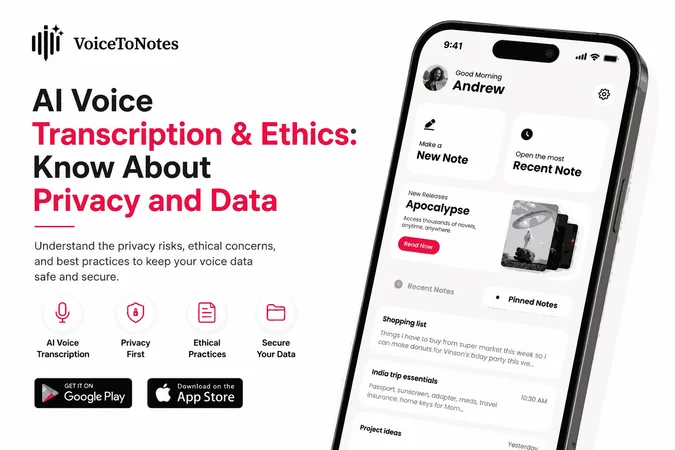
AI Voice transcription changed how people record conversations, meetings, interviews, lectures and personal notes.
Instead of learning to type, users can simply capture audio and then let the speech be transcribed into readable text within minutes.
Before understanding privacy, it's helpful to understand AI transcription and how modern transcription technology works.
It boosts productivity and saves time, but it also raises a question: What happens to your voice recordings once you upload them?
Some voice recordings might hold confidential data or sensitive information. It's important to have a grasp on how your data is collected, stored and secured.
We're breaking down the essentials of AI voice transcription, the privacy risks and ethical concerns involved, and practical ways that you can keep your data secure.
What is AI Voice Transcription?
AI voice transcription is a process that transcribes spoken words into written text instantly through speech recognition and AI.
Modern voice recognition transcription software delivers faster and more accurate transcripts than traditional speech recognition systems.
How AI voice transcription works involves capturing audio, cleaning it, and then evaluating sound waves and recognizing individual words.
Modern transcriptions are able to handle various accents, natural speech, multiple speakers and AI generated summaries.
AI transcription is used for:
- Business meetings
- Online lectures
- Interviews and podcasts
- Medical notes
- Legal proceedings
- Journalistic (news) coverage, where AI transcription tools for journalists make interview transcription faster while protecting sensitive recordings.
- Personal voice memos
Why Privacy Matters In AI Voice Transcription
The tools for transcribing voices with AI record personal and sometimes private conversations.
Without adequate security controls, your data could be exposed, shared without your permission or accessed by an unauthorized person. This is why privacy should be at the top of your list when choosing an AI transcription service.
Privacy controls should be considered for the following reasons:
- Prevents data leaks: Meetings, interviews, medical calls and business calls can involve private data that must be maintained confidentially.
- Protects against unauthorized visitors: Robust security controls can keep unwanted visitors from accessing or downloading your transcript data.
- Protect your data: Encryption during uploading, storing and sharing of data helps prevent malicious activity or cyberattacks.
- User Trust: When users know that your transcription data and recordings are handled with trust, they are more likely to use a transcription tool.
- Complies with regulations: Transcription must be safe as organizations must be required to meet privacy regulations such as GDPR or HIPAA.
- Data Control: A reliable transcription tool provides you with control of your data by allowing you to decide who will have access to your recordings and also allows you to delete your data at any time.
What Privacy Features Should You Check Before Choosing an AI Transcription Tool?
A fast AI transcription tool is helpful but keeping your recordings private is more important. If you're comparing different services, check our guide to the best transcription apps. Spend a few minutes to see how the platform handles your data and how your data is secure.
Following are the points should look before choosing AI transcription tool:
- Encryption: Your audio files and transcripts should be secure when uploaded and stored.
- Privacy Policy: Choose a service that clearly states what information it collects and how it is used.
- Data Control: Ensure you have the ability to delete your recordings when they are no longer needed.
- AI Training: Learn if your recordings are used to train AI models and if you can opt out.
- Security: Two factor authentication helps keep your account safe.
- Compliance: When dealing with sensitive information, look for tools that meet privacy standards like GDPR, CCPA or HIPAA.
- Ownership: Your recordings and transcripts are yours, not the company’s.
Ethical Considerations of AI Voice Transcription
AI voice transcription is about more than simply converting speech into text. It also involves protecting people's privacy, using AI responsibly, and ensuring that transcripts accurately reflect what was actually said.
Record Conversations Responsibly
Before recording meetings, interviews, phone calls, or conversations, make sure everyone involved understands that the conversation is being recorded. Depending on your location, recording someone without their knowledge or consent may also have legal implications.
AI Should Assist, Not Replace Human Judgment
AI transcription can save hours of manual work, but it shouldn't replace human review. If you're working with legal documents, medical records, research interviews, financial discussions, or other sensitive information, always verify the transcript before sharing or making important decisions based on it.
Speech Recognition Isn't Perfect
Modern AI transcription has improved dramatically, but no system is completely error-free. Different accents, overlapping speakers, background noise, technical terminology, and poor recording quality can still reduce accuracy. During my research, I found that speaker separation often had a bigger impact on transcript quality than raw speech recognition accuracy.
Review AI-Generated Content Carefully
Many transcription platforms now generate summaries, titles, action items, and rewritten text using AI. While these features can save time, they may occasionally omit important context, assign comments to the wrong speaker, or slightly change the intended meaning. A quick human review helps ensure the transcript accurately reflects the original conversation.
Transparency Builds Trust
Whether you're sharing transcripts with clients, colleagues, students, or customers, it's good practice to be transparent about how AI was used. Letting others know that a transcript or summary was generated with AI—and reviewed by a person when necessary helps build trust and reduces misunderstandings.
Ultimately, responsible AI transcription is about finding the right balance between speed, privacy, accuracy, and accountability.
My Experience Reviewing Privacy Features
While researching and comparing AI transcription platforms for this guide, I noticed that privacy practices varied much more than I expected.
Some providers clearly explained how recordings were encrypted, where they were stored, how long they were retained, and whether users could permanently delete them. Others offered very little information, making it difficult to understand exactly what happened to uploaded recordings.
One thing that stood out during my research was how differently companies handled AI training. Some platforms clearly explained whether customer recordings could be used to improve their AI models and whether users could opt out. In other cases, I had to search through multiple support articles and lengthy privacy policies to find the same information.
That experience reinforced an important lesson: don't judge a transcription platform only by its accuracy or feature list. Before uploading meetings, interviews, medical notes, legal conversations, or other confidential recordings, spend a few minutes reviewing the platform's privacy policy, security practices, and data controls. Those details matter just as much as transcription quality.
How I Evaluated Privacy
Privacy was evaluated using the same practical framework across every transcription platform I researched. Rather than relying solely on marketing claims, I reviewed how clearly each company explained its privacy practices and how much control users had over their own data.
The evaluation focused on:
- Privacy policy transparency
- Data retention practices
- Audio and transcript encryption
- AI training and data usage policies
- User ownership and control of recordings
- Account security features, including two-factor authentication
- Compliance with privacy standards such as GDPR, CCPA, or HIPAA, where applicable
- Data deletion and export options
- Overall transparency about how recordings are processed and stored
I didn't judge a platform based on a single privacy feature. Instead, I looked at the overall transparency of how user recordings were collected, processed, protected, shared, and deleted. In my experience, the most trustworthy transcription platforms weren't necessarily the ones with the longest feature lists—they were the ones that clearly explained how they handled user data and gave users meaningful control over their recordings.
Privacy Questions to Ask Before Uploading Any Recording
Before uploading a meeting, interview, lecture, or personal conversation to an AI transcription tool, ask yourself:
- Does the platform encrypt recordings while they're being uploaded and stored?
- Can I permanently delete my recordings and transcripts whenever I want?
- Will my recordings be used to train AI models, and can I opt out if they are?
- Does the privacy policy clearly explain how my data is processed and stored?
- Can I export my transcripts before deleting my account?
- Does the platform offer account security features such as two-factor authentication?
- If I'm handling sensitive business, legal, or medical information, does the service provide appropriate privacy and compliance features?
Taking a few minutes to answer these questions before uploading sensitive recordings can help you choose a transcription platform that protects both your data and the people whose conversations you're recording.
Benefits of AI Voice Transcription
Whether you’re in meetings, taking notes during lectures, or capturing ideas on the go, it helps you save time and stay organized. Many automatic transcription software solutions now include encryption, speaker detection, and AI summaries.
Key Advantages of AI Voice Transcription:
- Saves time: It converts speech to text in minutes, which is much faster than transcribing long recordings by hand.
- Reduces manual work: You don’t need to take notes during the conversation, you can be focused and let the tool do the transcription.
- Boosts productivity: It generates searchable transcripts of meetings, interviews, lectures, and voice notes, making it easier to find important details later.
- Enhances accessibility: Transcripts and captions provide an easier way for people who prefer reading or those with hearing challenges to access spoken content.
- Economical solution: AI transcription is a cheaper alternative to traditional manual services for many businesses and individuals.
For example, if you are a businessman or a doctor, then protecting client or patient information is more important and searching for a safe Voice transcription tool that keeps your data safe and protected.
Conclusion
Choosing a transcription tool that takes your privacy seriously shouldn't be complicated. AI transcription accuracy depends on recording quality, speaker clarity, and the underlying AI model. Avoiding common transcription mistakes can improve transcript quality while reducing editing time.
Consider VoiceToNotes.ai, it combines fast and accurate speech to text conversion with useful features like AI generated summaries, support for multiple languages, and secure handling of your recordings and transcripts.
Whether you're studying, covering interviews, managing meetings, or creating content, VoiceToNotes.ai helps you capture conversations more efficiently while keeping your data protected.
Frequently ASked Questions (FAQs):
1. Is AI voice transcription safe?
Yes, if the service is secure. Check for encryption, a clear privacy policy, and easy data control or deletion.
2. Will my AI transcriptions stay private?
Most reputable software like VoiceToNotes.ai is set to safeguard user’s information with strong privacy and security.
3. Is my AI transcription recording used to train the tool?
Some cloud based AI transcription services use recordings to improve their systems, while others don't. A trusted provider clearly explains this in its privacy policy.
4. Which aspects do you really want to look for in an AI transcribing instrument?
Look for good accuracy, strong security, data encryption, and clear privacy practices.
5. Why must privacy be so important when working with AI voice transcribing?
Voice recordings may contain personal or sensitive information, so keeping them secure is essential.
6. Is AI transcription excellent for business?
Yes. A lot of corporations depend on AI to quickly transcribe meetings, records, interviews or write down their notes.
7. How can one keep recordings secure?
Use a trusted platform, choose a strong password, enable two factor authentication if available, and delete files you no longer need.
8. Why consider utilizing VoiceToNotes.ai?
VoiceToNotes.ai offers fast transcription, smart summaries, multilingual support, and secure data handling in one easy to use platform.
Disclosure: VoiceToNotes is developed by our team and is included in this comparison. To maintain fairness, every product is evaluated using the same review criteria.
![Cover for 10 Best Speech-to-Text Apps for Android in 2026 [Free & Paid]](/Android speech to text app.webp)
.webp)
.png)